


Carbon fibre 3D printing: which CF filament for which part

Updated: 6 days ago
Carbon fibre 3D printing uses filament loaded with chopped carbon fibre, which makes a part markedly stiffer and more dimensionally stable than the same part unfilled. 3Descu prints three carbon fibre grades in FDM, all priced instantly: carbon fibre filled for jigs and fixtures that must hold position, PETG CF for brackets that bend in plain PETG, and ABS CF for large or warm parts that bow in plain ABS. Choose fibre for stiffness, not for impact: it makes a part resist bending and makes it less tolerant of a hard knock.
All three come out matte and slightly textured, which hides layer lines and often means no finishing. They are printed in filament on the 3Descu fleet of 200+ printers in Targu-Jiu, Romania.
Get a free quote - no account, and nothing is charged before you accept the offer.
The three carbon fibre grades at 3Descu: key facts
Carbon fibre filled | |
Best for | Jigs and fixtures that must hold position; stiff structural brackets; drone and robotics frames; parts that would otherwise be machined aluminium |
Wrong for | Parts that need to flex; impact-facing parts; fine cosmetic detail |
Heat | High |
Stiffness | Very high |
Impact | Low |
Outdoors / UV | Short term only |
Water and chemicals | Not rated |
Finish | Matte, slightly rough |
Material page | |
PETG CF | |
Best for | Structural brackets and mounts; drone and RC parts; jigs that must not flex; long flat parts that warp in plain PETG |
Wrong for | Parts that need to bend rather than break; fine cosmetic detail; transparent or glossy finishes |
Heat | Medium |
Stiffness | High |
Impact | Low |
Outdoors / UV | Short term only |
Water and chemicals | Same resistance as PETG |
Finish | Matte, slightly textured |
Material page | |
ABS CF | |
Best for | Parts that live near heat; large flat panels that bow in plain ABS; tooling and production jigs; housings that will be drilled or tapped |
Wrong for | Parts that need to flex; outdoor parts in direct sun over months; fine cosmetic detail straight off the machine |
Heat | High |
Stiffness | Very high |
Impact | Medium |
Outdoors / UV | Not suitable |
Water and chemicals | Not rated |
Finish | Matte; does not take acetone smoothing |
Material page | |
For all three: 13 standard colours in the calculator, with a RAL or Pantone code on request; parts go up to 320 x 320 x 320 mm on the standard fleet and up to 500 x 500 x 500 mm on the large-format machines; layer height runs from 0.12 mm to 0.28 mm, 0.20 mm by default; and the price appears instantly from your file.
These are working classifications used when advising on a part, not measured figures. A printed part does not have the properties of the spool it came from: orientation, walls and infill all change the result, so write any critical load in the notes on the quote.
What carbon fibre actually buys: stiffness, not toughness
"Carbon fibre" sounds like strength, which is where wrong orders start. The fibre buys two things: stiffness, which is resistance to bending, and dimensional stability, which is holding shape as the part cools and over time. It costs toughness. A carbon-filled part resists bending; it does not resist a hard knock better than its base polymer, and often worse.
So the right question is how the part fails. If it bends, deflects or slowly creeps out of position, fibre fixes it. If it cracks when dropped or hit, fibre makes it worse, and the answer is polycarbonate or PC-ABS; see the polycarbonate guide.
On weight: a printed carbon fibre part is lighter than the machined aluminium part it sometimes replaces, but it is not as stiff or as strong as aluminium. It replaces aluminium where the metal was chosen for convenience rather than for the load, such as fixtures, frames and brackets in automation cells. 3Descu does not print metal, so a part that truly has to be metal needs a metal supplier.
Which carbon fibre grade for which job
Carbon fibre filled: fixtures that must not move
The general-purpose stiff grade, for a fixture that holds a workpiece in position, a locating nest, a gauge, or a frame that must not deflect or creep.
PETG CF: the upgrade from a PETG part that bends
PETG CF keeps PETG's resistance to water and cleaning agents and its easy printing, with much less flex and far less warping on long flat geometry. Pick it when a PETG bracket holds its shape at rest but bends under load: the failure you are designing against is deflection, not fracture. It is abrasive and prints slower than plain PETG, which shows up in the lead time on a large order rather than in the price of one part. The PETG guide covers the base material.
ABS CF: large or warm parts that must stay flat
ABS CF solves the one thing that makes large ABS parts difficult: shrinkage. A long flat panel that would bow in plain ABS holds its shape in ABS CF, while keeping ABS heat resistance and machinability. It also rates Medium on impact, the most forgiving of the three if a jig gets knocked on a line. Unlike plain ABS it does not take acetone smoothing, because the fibre stays proud of the softened surface. The ABS guide covers the base material.
Quick decision table
The part... | Choose |
Must hold a workpiece in position without creep | Carbon fibre filled |
Is a PETG bracket that bends under load | PETG CF |
Meets water or cleaning agents and must be stiff | PETG CF |
Is a long flat panel that bows in ABS | ABS CF |
Sits near heat and must hold a dimension | ABS CF |
Will be drilled or tapped after printing | ABS CF |
When carbon fibre is the wrong choice
The part must flex. Snap fits, living hinges and clips need toughness, not stiffness. Nylon PA12 is the filament for repeated flexing; see the nylon PA12 guide.
The part takes impact. Guards and housings that get dropped belong in polycarbonate or PC-ABS.
The surface is the point. Fine cosmetic detail, gloss or transparency are outside what a fibre-filled filament gives. Small detailed parts go to resin.
The part lives outdoors for months. ABS CF is not suitable outdoors, and the other two grades are short term only. ASA is the outdoor filament.
Design rules for carbon fibre parts
The 3Descu design rules apply to all three grades. The points that matter most:
Layer direction still decides strength. The fibre stiffens the part within each layer; the bond between layers is still the base polymer. Say in the notes which way the load comes from.
Put the material in the walls. A stiff bracket is stiff because of its shell. Four or five walls do more than extra infill; draw walls in multiples of the 0.42 mm bead.
Use the stability on long parts. PETG CF and ABS CF are the answer when a long flat part warps in the unfilled grade. Very long parts have their own rules, in the large-format 3D printing guide.
Threads and holes. Use heat-set inserts for fasteners that get undone more than once. ABS CF housings can be drilled or tapped after printing.
Finishing. The matte surface hides layer lines better than any unfilled filament and often needs no finishing. Do not plan on acetone smoothing ABS CF.
Carbon fibre grades vs their base polymers
Material | Heat | Stiffness |
PETG | Medium | Medium |
PETG CF | Medium | High |
ABS | High | Medium |
ABS CF | High | Very high |
Carbon fibre filled | High | Very high |
Nylon PA12 | High | Medium |
Material | Impact | Outdoors |
PETG | Medium | Short term only |
PETG CF | Low | Short term only |
ABS | High | Not suitable |
ABS CF | Medium | Not suitable |
Carbon fibre filled | Low | Short term only |
Nylon PA12 | High | Short term only |
Fibre moves stiffness up and impact down. The whole range is in the 3D printing materials overview.
How to order carbon fibre parts at 3Descu
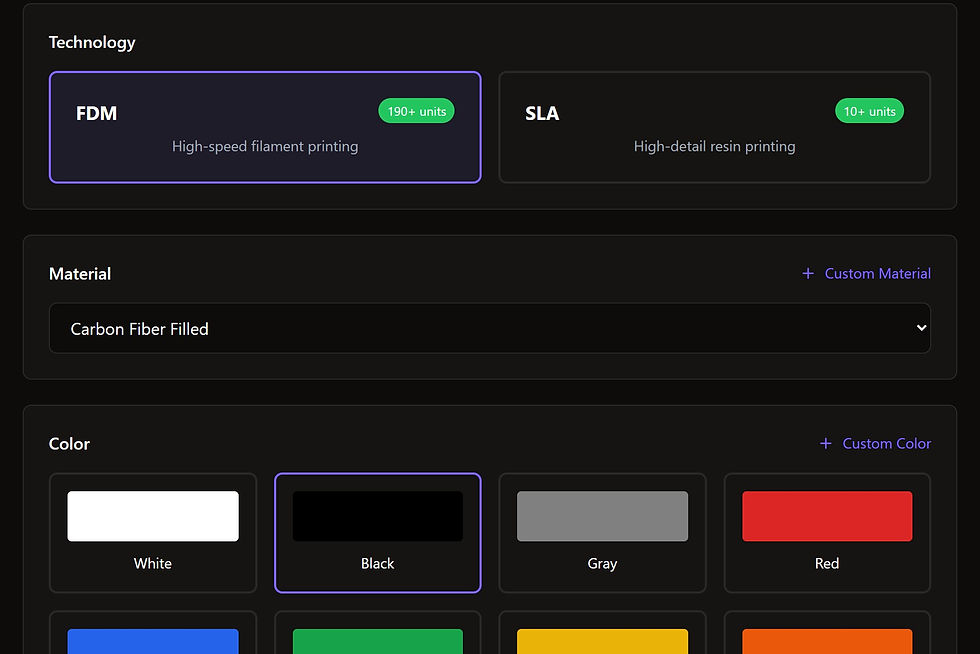
Upload the file to the calculator.
Choose FDM, then Carbon Fiber Filled, PETG CF or ABS CF, a colour and an infill. Raise the wall count for brackets and fixtures.
In the notes, write the load direction, the dimension that must hold, and whether the part will be drilled or tapped.
Re-price the same file in the other two grades; switching material re-prices it in seconds.
Submit. A person replies the same business day with the confirmed price.
A carbon fibre grade not on the list, such as PA12-CF, goes through "Custom material": an engineer sources it and replies with a price the same business day. The minimum order is €20 per order, not per part.
Carbon fibre filament in short
Carbon fibre filament makes a part stiffer and more dimensionally stable than the same polymer unfilled, not tougher.
Stiffest grades: carbon fibre filled and ABS CF, both rated Very high. PETG CF rates High.
PETG CF vs ABS CF: PETG CF for water, cleaning agents and PETG parts that bend; ABS CF for heat, large flat parts and parts to be drilled or tapped.
Replacing aluminium: possible on fixtures, frames and brackets where the metal was chosen for convenience, not load.
Finishing: usually none. The matte surface hides layer lines, and ABS CF cannot be acetone smoothed.
A fixture is only useful if it is right
A carbon fibre part is usually bought to hold a dimension, so the checks matter. Every CF quote at 3Descu is read by a person who checks the grade against how the part will fail, and the reply says so if another grade fits better. On request, you get photos at any production stage and a dimensional QC report, free on orders over €500, from an ISO 9001:2015 certified quality system. If a delivered part does not conform to the agreed specification: reprint or refund, in writing, under Article 5.5 of our manufacturing contract.
Get a free quote and price the same fixture in all three carbon fibre grades.


Comments