


Resin 3D printing (SLA): the five resins and when to use them

Updated: 5 days ago
Resin 3D printing (SLA) cures liquid photopolymer layer by layer and produces parts with far finer detail and a smoother surface than any filament process. At 3Descu it is the process for small, intricate parts and parts that have to look moulded rather than printed: miniatures and detailed models, jewellery masters and castable patterns, dental and medical models, and small parts with fine surface texture. Choose resin when the detail is finer than a 0.42 mm filament nozzle can lay down; choose filament when the part has to carry load, take impact or live in daylight.
3Descu runs resin printers alongside filament printers, 200+ machines on one floor in Targu-Jiu, Romania, and the calculator prices all five resins instantly from your file.
Get a free quote - no account, and nothing is charged before you accept the offer.
Resin 3D printing at 3Descu: key facts
Resin (SLA) | |
Best for | Miniatures and highly detailed models; jewellery masters and castable patterns; dental and medical models; small parts with fine surface texture |
Wrong for | Large parts, which the build volume limits; load-bearing or impact parts; anything left in daylight |
Heat | Low (standard resin) |
Stiffness | High (standard resin) |
Impact | Low (standard resin) |
Outdoors / UV | Not suitable: resin degrades in sunlight |
Finish | Smooth, looks moulded without finishing; support marks sanded off |
Colours | 13 standard colours in the calculator, plus transparent, which is offered on resin only; a RAL or Pantone code on request |
Printed on | Our own resin printers, masked stereolithography (MSLA) |
Largest part | 300 x 250 x 250 mm |
Internal fill | Prints solid; there is no infill setting |
How it is priced | Instantly in the calculator, all five resins |
Heat, stiffness and impact above are our working classifications for standard resin, not measured figures. As with any printed part, orientation and geometry change how it behaves, so a critical requirement belongs in the notes on the quote.
The five resins 3Descu prints
Resin | Character | Typical use |
Standard resin | High detail, smooth surface | Visual models, prototypes, miniatures |
Tough resin | Higher strength and impact resistance within the resin range | Functional prototypes, snap fit trials |
Flexible resin | Rubber-like | Detailed grips, gaskets and seals |
Castable resin | Made for investment casting | Jewellery and dental patterns |
Water-washable resin | Easy cleanup | General purpose prototypes |
Standard resin is the default for anything where detail and surface are the point. Tough resin is the pick when a resin prototype has to be handled, assembled or trial-fitted; it is tougher than standard resin, but it is still resin, so a part that flexes in service belongs in filament. Flexible resin makes small rubber-like parts with detail TPU cannot reach; for a larger or harder-working gasket or grip, TPU filament is the better material, as the TPU guide explains. Castable resin is for patterns that are burned out of an investment mould, the route for jewellery and dental castings. Water-washable resin is a general purpose option for prototypes.
When resin beats FDM
Resin wins on three things: detail, surface and small size.
Detail finer than a nozzle bead. A filament nozzle lays a 0.42 mm bead. Lettering, textures, thin ribs and sharp edges below that come out soft in FDM and crisp in resin. A part that looks soft in FDM is usually a resin part.
A surface that has to look moulded. Display models, presentation pieces and product mock-ups come off a resin printer without visible layer lines.
Masters and patterns. Jewellery masters, dental models and castable patterns need both the detail and the smooth surface.
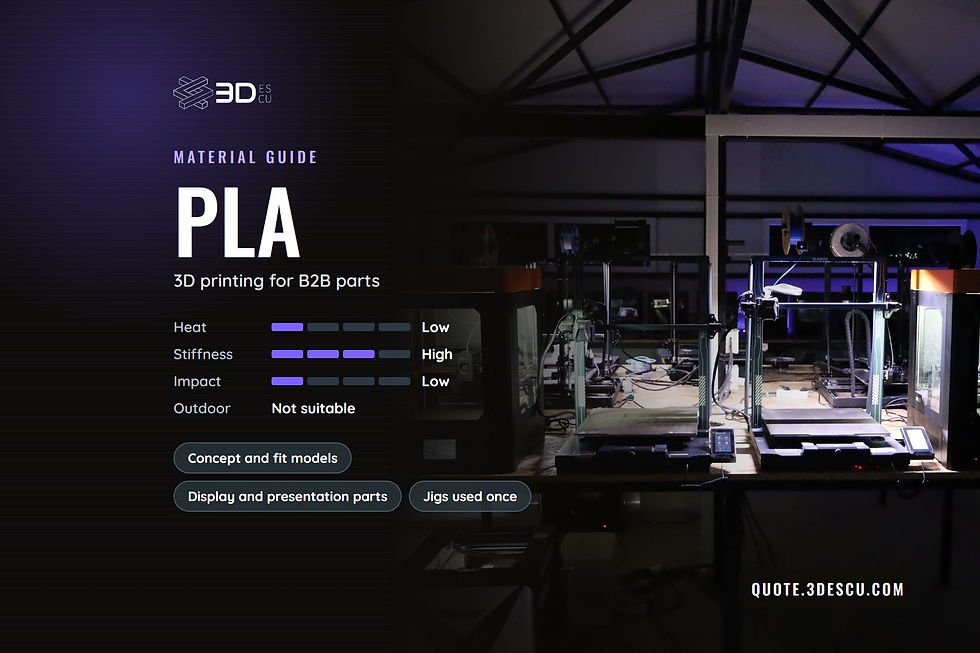
Against PLA, which is the usual filament for visual models, resin gives far finer detail and a smoother surface on a small part; PLA wins on size, since filament goes up to 500 x 500 x 500 mm against 300 x 250 x 250 mm for resin. The PLA guide covers where PLA is the better call. The full process comparison is in FDM vs resin 3D printing.
When resin is the wrong choice
Cured photopolymer is stiff and brittle, and it degrades in sunlight. That sets the limits.
If the part... | Choose instead |
Carries load or takes impact | A filament such as PETG, ABS or polycarbonate |
Flexes repeatedly, like a snap fit or living hinge | Nylon PA12, see the nylon PA12 guide |
Lives outdoors or in daylight | ASA filament |
Is larger than 300 x 250 x 250 mm | Filament, or a split resin part |
Is a large gasket or grip | TPU filament |
There is no large-format resin machine at 3Descu, so a part past the resin build volume is either split or printed in filament, and for most parts that size filament is the right answer anyway.
Design rules for resin parts
Resin has its own rules, set out on the 3Descu design rules page. These are the ones that decide whether a resin part survives.
Every enclosed cavity needs a drain hole, ideally two. The part comes out of a vat of liquid. A sealed hollow fills with uncured resin that cannot be washed out, so the part stays heavy, keeps curing, and can eventually crack. One hole traps air; two let it drain.
Hollowing is your call, in CAD. Resin prints solid in the calculator. If you hollow a part to save material, add the drain holes as above.
Choose the show face. A resin part is grown hanging off supports, and every contact point leaves a small witness mark that is sanded off. Say in the notes which face must be clean, and the supports go elsewhere.
Design it as a detail part, not a hinge. Snap fits and living hinges in cured resin snap. Tough resin is fine for trial fits; a part that flexes in service belongs on the filament side.
Wash and cure are part of the process. Every resin part is washed and cured on the resin bench after it comes off the plate. You receive a cured part.
Minimum features. We do not publish a minimum feature size, because none has been measured on parts from these machines yet. If a feature is very fine, point to it in the notes and it is checked before printing.
Getting the file itself right, including units and export format, is covered in preparing a file for 3D printing.
Resin compared with the filaments people weigh it against
Material | Heat | Stiffness |
Standard resin | Low | High |
PLA | Low | High |
PETG | Medium | Medium |
TPU | Medium | Flexible by design |
Material | Impact | Outdoors |
Standard resin | Low | Not suitable |
PLA | Low | Not suitable |
PETG | Medium | Short term only |
TPU | High | Short term only |
Material | Detail |
Standard resin | Finest in the range |
PLA | Limited by the 0.42 mm bead |
PETG | Limited by the 0.42 mm bead |
TPU | Limited by the 0.42 mm bead |
Every material in the range is compared in the 3D printing materials overview.
How to order resin parts at 3Descu
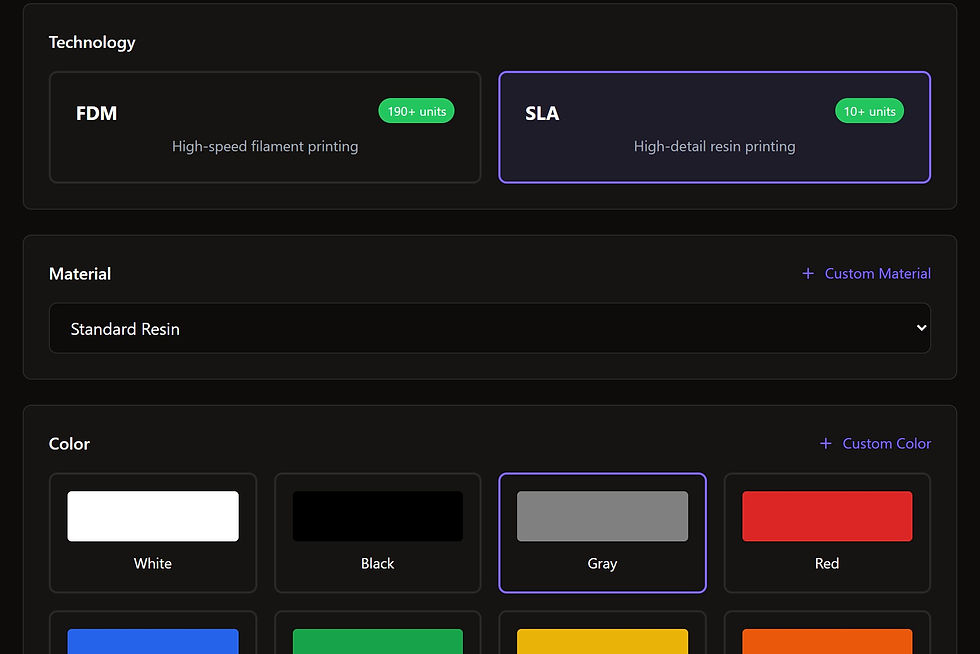
Upload an STL, STEP, OBJ or 3MF file to the calculator. It shows whether the part fits the resin build volume.
Set the technology to SLA, then choose the resin and a colour. Transparent is available on resin.
In the notes, name the show face, any very fine feature and, for a casting pattern, the casting route.
Enter the quantity. Resin cures a whole layer at once, so several small parts can share a plate.
Submit. A person replies the same business day with the confirmed price.
A resin not on the list, for example a specific dental or engineering grade, goes through "Custom material" and is priced by hand, the same business day. The minimum order is €20 per order, not per part.
Resin 3D printing in short
Resin vs FDM strength: cured resin is stiff but brittle, and even tough resin is for prototypes and trial fits. Load, flex and impact go to filament.
Outdoors: resin degrades in sunlight, so daylight parts go to a filament such as ASA.
Largest resin part: 300 x 250 x 250 mm in one piece. Larger parts are split or printed in filament.
Castable resin: one of the five standard resins, priced instantly, made for investment casting patterns including jewellery and dental work.
Transparent parts: transparent is offered as a colour on resin only.
Biocompatible grades: a certified grade is requested by its exact name under "Custom material" and priced by hand.
Detail you can check, and designs that stay private
Resin work is usually the visible or confidential kind: a jewellery master, a product mock-up, a dental model. Every resin quote at 3Descu is read by a person before an invoice is issued, who checks that resin is the right process for the part and says so if filament would serve it better. Photos at any production stage are available on request, so you can see the show face before the parcel leaves, and a dimensional QC report is free on orders over €500, under an ISO 9001:2015 certified quality system. Your files are encrypted in transit and at rest in EU storage and deleted automatically 90 days after upload.
Get a free quote - set the technology to SLA and see the resin price on your own file.

Comments