


FDM vs resin 3D printing: which process for which part

Updated: 5 days ago
FDM and resin are the two main plastic 3D printing processes, and they suit different parts. FDM (fused deposition modelling) builds a part by laying molten plastic filament down through a moving nozzle, and it is the process for functional parts in real engineering plastics, at large sizes and in quantity. Resin printing (SLA) cures liquid photopolymer with light one thin layer at a time, and it is the process for small parts where fine detail and a smooth surface are the point.
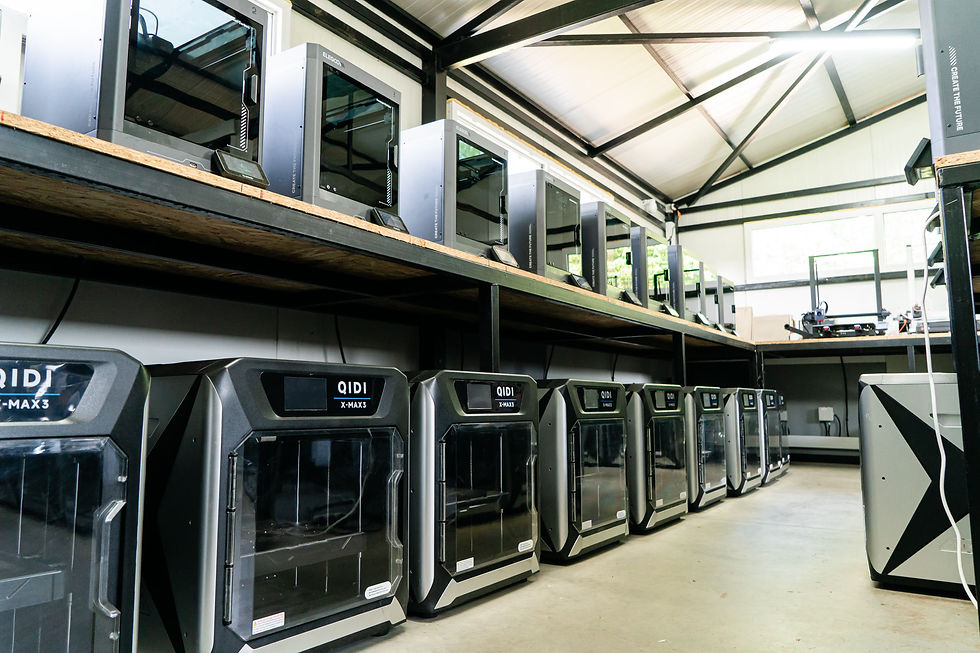
3Descu runs both processes on one production floor in Targu-Jiu, Romania, with 200+ 3D printers in total. The company is ISO 9001:2015 certified. Because the 3Descu calculator prices both, you can upload one file and compare the two processes on the same part in seconds.
FDM vs resin at 3Descu: the comparison table
FDM (filament) | Resin (SLA) | |
How it builds a part | Molten filament laid down in layers through a nozzle | Liquid photopolymer cured by light, layer by layer |
Largest part at 3Descu | 500 x 500 x 500 mm | 300 x 250 x 250 mm |
Layer height | Fine, Standard (0.2 mm) or Fast | 0.025 mm |
Surface off the machine | Visible layer lines | Smooth, looks moulded without finishing |
Fine detail | Limited by the 0.42 mm nozzle bead | Resolves detail a nozzle cannot lay down |
Mechanical behaviour | Tough, real engineering plastics | Stiff and brittle when cured |
Sunlight | ASA is suitable outdoors | Degrades in daylight |
Internal fill | Adjustable infill, 10% to 100% | Prints solid |
Materials in the calculator | 12 filaments | 5 resins |
Colours in the calculator | 13 standard colours | 13 standard colours plus transparent |
Best for | Functional prototypes, jigs, fixtures, housings, brackets, spare parts, production runs | Miniatures, detailed models, jewellery masters, dental and medical models, small textured parts |
Wrong for | Parts where a crisp cosmetic surface is the whole point | Large parts, load-bearing or impact parts, anything left in daylight |
No dimensional tolerance is listed for either process. 3Descu has not yet measured one on its own parts, and a figure copied from a data sheet is not a tolerance a printed part holds. If your part has a stated tolerance, send the drawing with the file and it is answered directly.
What FDM 3D printing is good for
FDM is the process behind almost every functional printed part, because it runs in real engineering plastics and scales to large geometry and to hundreds of pieces. It trades surface finish for strength, size and cost. At 3Descu the filament range covers PLA, PETG, ABS, ASA, TPU, Nylon PA12, polycarbonate, PC-ABS, carbon fibre filled, PETG CF, ABS CF and wood filled PLA.
That range is the real advantage. PETG covers most functional parts. ABS or ASA covers anything warm or outdoors, with ASA the choice for sunlight. Nylon PA12 covers parts that flex or wear repeatedly, such as gears, hinges and snap fits. TPU covers parts whose job is to bend and come back, such as gaskets and grips. Carbon fibre filled grades cover jigs and brackets that must not flex.
Two FDM design facts matter before you order. A printed part is strongest along a layer and weakest between two layers, so say which direction the load comes from in the notes. And walls carry the load, not the infill, so a structural part is better served by another wall than by more infill. More on the process is on the 3Descu FDM 3D printing page.
What resin (SLA) 3D printing is good for
Resin printing resolves detail an extrusion nozzle cannot reach, and it leaves a surface that needs no finishing to look moulded. It is the right process when the part is small, intricate, or has to look moulded rather than printed. At 3Descu the resin range covers standard, tough, flexible, castable and water-washable resin. Castable resin is for jewellery and investment casting patterns, and flexible resin is for small grips, gaskets and seals.
Resin has two limits. The first is build volume: anything over 300 x 250 x 250 mm is either split or printed in filament, and for most parts that size filament is the right answer anyway. The second is the material itself. Cured photopolymer is stiff and brittle, so a snap fit or living hinge in standard resin snaps, and resin degrades in sunlight. Resin suits models, masters and detail work rather than working mechanical components.
Resin has its own design rules. Every enclosed cavity needs a drain hole, ideally two, because a sealed hollow fills with uncured resin that cannot be washed out. And every support contact leaves a small mark that is sanded off, so tell 3Descu which face is the show face. See the 3Descu resin 3D printing page and the standard resin material page.
How to choose between FDM and resin
Choose FDM when any of these is true:
The part has a mechanical job: it carries load, is fastened, flexes or takes impact.
The part is larger than 300 x 250 x 250 mm.
The part lives outdoors or near heat (ASA, ABS, PC-ABS or polycarbonate).
You need tens or hundreds of pieces of a functional part.
Cost per piece matters more than surface finish.
Choose resin when any of these is true:
The detail is finer than a 0.42 mm nozzle can lay down, so the part would look soft in FDM.
The surface is the point: display models, miniatures, presentation pieces.
The part is a master or pattern, such as a jewellery master or a castable pattern.
The part is small and will live indoors.
If a part fits both lists, price it both ways. In the 3Descu calculator, switching the technology from FDM to SLA re-prices the same file, so the trade between surface and cost is visible before you decide. The 3Descu design rules list the rules for each process.
When neither FDM nor resin is the answer
3Descu runs FDM and resin only, by design. It does not run SLS, MJF, metal printing (DMLS or SLM) or injection moulding. CNC machining is available on request through the 3Descu partner network. Printed nylon in filament covers most parts that get specified as SLS or MJF, but not all of them, and nothing here substitutes for a part that has to be metal. Past a few thousand identical parts that will not change, injection moulding is cheaper per piece and printing is the wrong process. The 3Descu page on what we do not print says which process to look for instead.
Get a free quote - upload one file and price it in FDM and in resin.

Comments