


3D printing materials for functional parts compared

Updated: 6 days ago
A 3D printing material for a functional part is chosen by what the part has to survive in service: heat, load, repeated flexing, sunlight or chemicals. For most indoor functional parts the answer is PETG. Parts that get warm move to ABS, PC-ABS or polycarbonate, parts that live outdoors move to ASA, and parts that wear or flex thousands of times move to nylon PA12.
Every other material in the range solves a narrower problem, and the table below shows which. We print all of them on a fleet of 200+ printers in Targu-Jiu, Romania, under an ISO 9001:2015 certified quality system, and the calculator prices each one on your own file.
Get a free quote and price the same part in two or three materials before you commit to one.
Filament materials for functional parts compared
These are our working classifications, qualitative on purpose, and the same ones carried on each material page, where every material also lists what it is wrong for.
Material | Heat | Stiffness |
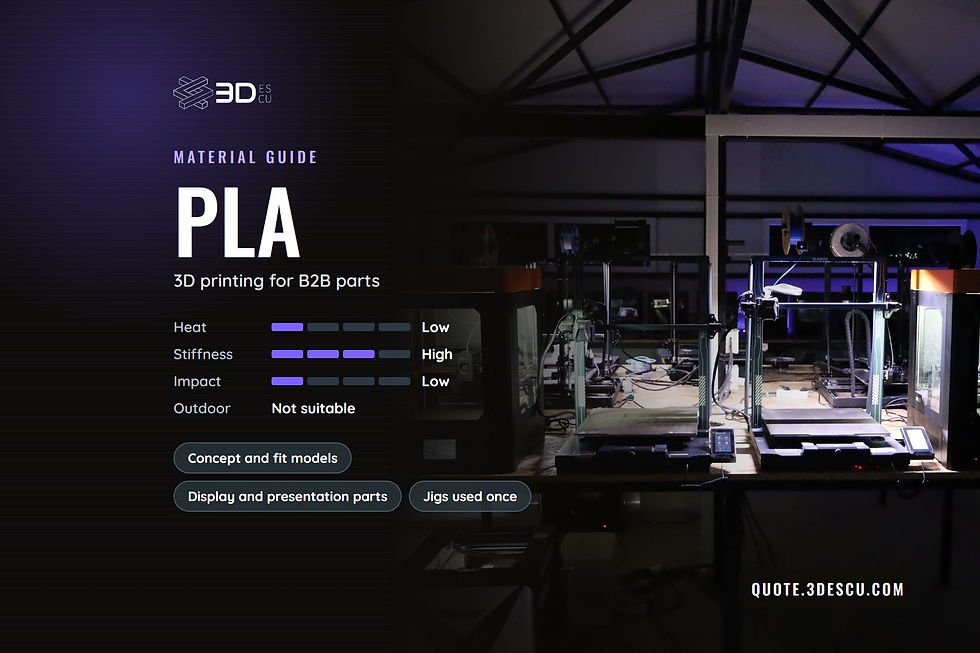
PLA | Low | High |
PETG | Medium | Medium |
PETG CF | Medium | High |
ABS | High | Medium |
ABS CF | High | Very high |
ASA | High | Medium |
Nylon PA12 | High | Medium |
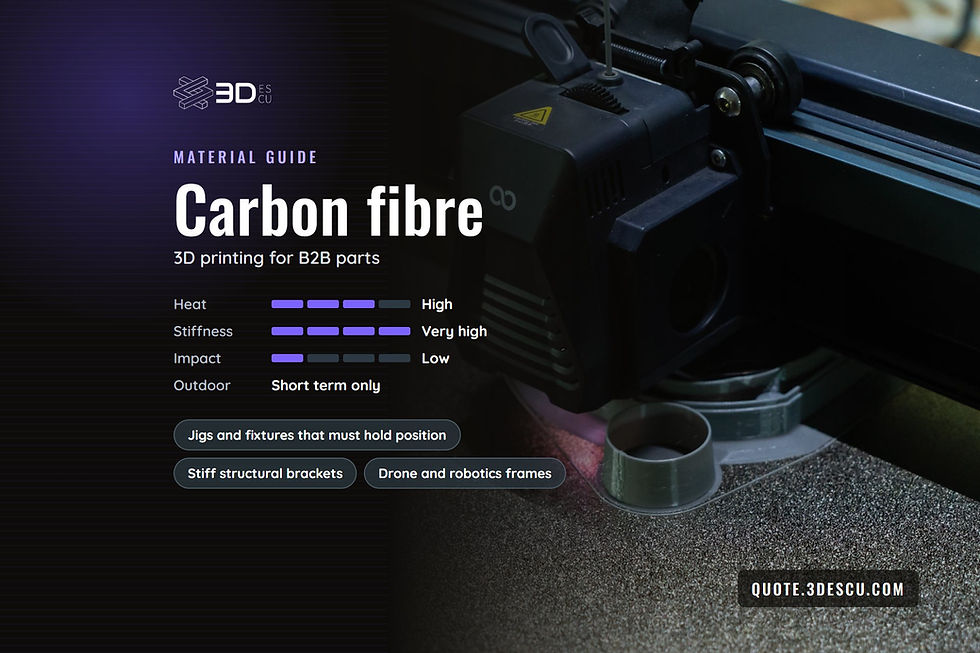
Carbon fibre filled | High | Very high |
Polycarbonate (PC) | Very high | High |
PC-ABS | High | High |
TPU | Medium | Flexible by design |
Material | Impact | Outdoor / UV |
PLA | Low | Not suitable |
PETG | Medium | Short term only |
PETG CF | Low | Short term only |
ABS | High | Not suitable |
ABS CF | Medium | Not suitable |
ASA | High | Suitable |
Nylon PA12 | High | Short term only |
Carbon fibre filled | Low | Short term only |
Polycarbonate (PC) | Very high | Short term only |
PC-ABS | Very high | Not suitable |
TPU | High | Short term only |
Material | Water and chemicals |
PLA | Not rated |
PETG | Resists water and most household chemicals |
PETG CF | Same resistance as PETG |
ABS | Softened by acetone, which is why it can be smoothed |
ABS CF | Not rated |
ASA | Not rated |
Nylon PA12 | Absorbs moisture from the air |
Carbon fibre filled | Not rated |
Polycarbonate (PC) | Not rated |
PC-ABS | Not rated |
TPU | Not rated |
Material | Typical functional use |
PLA | Fit and concept models, single-use jigs |
PETG | Housings, brackets and mounts indoors |
PETG CF | Stiff brackets, jigs that must not flex |
ABS | Parts near warm electronics, parts to be drilled or tapped |
ABS CF | Tooling, large flat panels, parts near heat |
ASA | Outdoor housings, mounts, exterior trim |
Nylon PA12 | Gears, hinges, snap fits, wear parts |
Carbon fibre filled | Fixtures that must hold position, frames |
Polycarbonate (PC) | High-temperature jigs, impact guards, structural parts |
PC-ABS | Automotive interior parts, housings that take knocks |
TPU | Gaskets, seals, grips, bumpers |
"Not rated" means we do not classify that material against chemicals. If a part will meet a specific fluid, name it in the notes on the quote and we answer for that fluid rather than for a category.
Heat, stiffness and impact are three different questions
"Strong" in a requirement usually means one of three separate things, and the materials rank differently on each.
Stiffness is resistance to bending. A fixture that flexes under clamping load has failed even if nothing broke. Carbon fibre filled and ABS CF are the stiffest in the range.
Impact is surviving a knock without cracking. Polycarbonate and PC-ABS lead here. Stiffness and impact pull against each other: fibre makes a part stiffer and less tolerant of a hard knock.
Heat is staying rigid when warm. PLA is stiff but softens at temperatures a closed car reaches in summer, so a PLA part near a motor or in a vehicle will deform.
A printed part is also strongest along a layer and weakest between layers, so say in the quote notes which direction the load comes from.

PETG vs PLA vs ABS for everyday functional parts
PETG is the sensible default for a part that will be handled, fastened or wetted. It bends before it breaks, its layers bond strongly, and it resists water and cleaning agents. See the PETG page for the full list of good and bad uses.
PLA holds its dimensions well because it barely shrinks as it cools. It is the right choice for fit checks and display parts, and the wrong one for anything warm, outdoors or under sustained load, because it fails by snapping rather than bending.
ABS is the traditional engineering thermoplastic: heat resistant, impact resistant, and easy to drill, tap, glue or smooth after printing. It shrinks as it cools, so long flat ABS parts want ribs or a split line.
ASA vs ABS for outdoor parts
ASA is ABS reformulated to survive sunlight. It keeps the heat and impact resistance and loses the yellowing and chalking that ends an ABS part left outside. If a part lives outdoors for more than a season, ASA is almost always the answer, and the price difference against ABS is small. UV resistance belongs to the polymer, not the colour, so a black ASA part and a light one both weather the same way. PETG copes outdoors only in the short term.
Nylon PA12 for parts that wear, slide and flex
A PETG part that keeps failing at the same point after repeated use has a fatigue problem, not a strength problem. Nylon PA12 is the filament for gears, cams, bushings, living hinges and snap fits: tougher and more fatigue resistant than the styrenics, with a naturally low friction surface. It takes up moisture from the air, so design clearances slightly looser than you would for PLA.
Carbon fibre filled, PETG CF and ABS CF
Chopped carbon fibre buys stiffness and dimensional stability, and it costs toughness. All three fibre-filled filaments come out matte and slightly textured, which hides layer lines.
Carbon fibre filled is the choice for jigs and fixtures that must hold position and must not creep.
PETG CF is the upgrade when a PETG bracket holds its shape at rest but bends under load. It keeps PETG's resistance to water and cleaning agents and warps far less on long flat geometry.
ABS CF solves the shrinkage that makes large ABS parts bow, while keeping ABS heat resistance and machinability. Unlike plain ABS, it does not take acetone smoothing.
Polycarbonate and PC-ABS for heat and load
Polycarbonate sits at the top of the range for heat resistance and impact strength. It stays rigid where ABS softens and takes a hard impact without shattering. It prints slowly at high temperature, so it carries more machine time than the same part in PETG. Specify it when the part has a stated service temperature or a stated load; otherwise ABS or PETG does the job for less.
PC-ABS keeps most of polycarbonate's toughness and heat resistance while printing more like ABS. It is the practical middle option for automotive interior parts and larger engineering parts where polycarbonate would be too slow.
TPU for parts that must deform
TPU is the only filament in the range that bends and returns to shape. It makes gaskets, seals, grips, bumpers and feet. Wall thickness sets its firmness more than infill does, and it prints slowly, so a TPU part costs more in machine time than its size suggests. It is the wrong choice for threads or for anything that must hold a dimension under load.
Resin materials and when a functional part needs one
Resin printing cures liquid photopolymer layer by layer. It produces far finer detail and a smoother surface than any filament, within a build volume of 300 x 250 x 250 mm. Cured resin is more brittle than filament and degrades in sunlight, so resin suits detail work and prototypes rather than working mechanical components.
Resin | Character | Typical use |
Standard resin | High detail, smooth surface | Visual models, prototypes |
Tough resin | Higher strength and impact resistance within the resin range | Functional prototypes, snap fit trials |
Flexible resin | Rubber-like | Detailed grips, gaskets and seals |
Castable resin | Made for investment casting | Jewellery and dental patterns |
Water-washable resin | Easy cleanup | General purpose prototypes |
If a part needs detail finer than a 0.42 mm nozzle can lay down, it is a resin part. If it has to flex repeatedly, carry load or live in daylight, it belongs on the filament side.
What this comparison deliberately leaves out
There are no tensile figures, heat deflection temperatures or dimensional tolerances in this post. A printed part does not have the properties of the spool it came from: orientation, layer height, walls and infill all change the result, and we have not yet measured test coupons off our own machines. We would rather publish nothing than a data sheet number that comes back as a rejected part. When a delivery has to meet a measured requirement, a QC report is available on request, free on orders over €500.
If the material you need is not in the list, such as an ESD-safe grade, choose "Custom material" in the calculator and type the exact name. It is not priced automatically; an engineer sources it and replies with a real price the same business day.
Get a free quote by uploading your file, picking two candidate materials and comparing the prices side by side.

Comments