


ABS 3D printing: the complete guide for engineering parts

Updated: 6 days ago
ABS 3D printing is the choice for engineering parts that get warm, take knocks, or need work after printing. ABS is the traditional engineering thermoplastic: heat resistant, impact resistant, and it can be drilled, tapped, glued, solvent bonded and acetone smoothed. The 3Descu ABS 3D printing service is used for housings near warm electronics, automotive and engineering parts and anything that will be machined after printing; outdoors the answer is ASA, and for large flat parts that must not bow it is ABS CF.
3Descu prints ABS on its own fleet of 200+ printers in Targu-Jiu, Romania. This guide covers what ABS is for, the one constraint that decides its design, what can be done to it after printing, and how it compares with its neighbours. For the whole range at a glance, see the materials overview.
ABS key facts
ABS at 3Descu | |
Best for | Engineering and automotive parts, parts that will be drilled or tapped, housings near warm electronics, parts to be glued or solvent bonded |
Avoid for | Very large flat panels in one piece, outdoor parts in direct sun over months, parts where dimensional accuracy matters more than toughness |
Heat | High |
Stiffness | Medium |
Impact | High |
Outdoor / UV | Not suitable: yellows and chalks in sunlight |
Water and chemicals | Softened by acetone, which is why it can be smoothed |
Main design constraint | Shrinks as it cools, so long flat parts bow |
After printing | Drilling, tapping, gluing, solvent bonding, acetone smoothing on request |
Colours | 13 standard colours in the calculator; a RAL or Pantone code on request |
Process and size | FDM, up to 320 x 320 x 320 mm on the standard fleet and up to 500 x 500 x 500 mm on the large-format machines |
Pricing | Instant in the calculator, no account needed |
Fibre-filled variant | ABS CF, also priced instantly |
These are the working classifications from the ABS material page, not figures from a filament data sheet. A printed part does not have the properties of the spool it came from: orientation, wall count and infill change the result. If a part carries a critical load or has a stated service temperature, put it in the notes on the quote.
When to choose ABS 3D printing
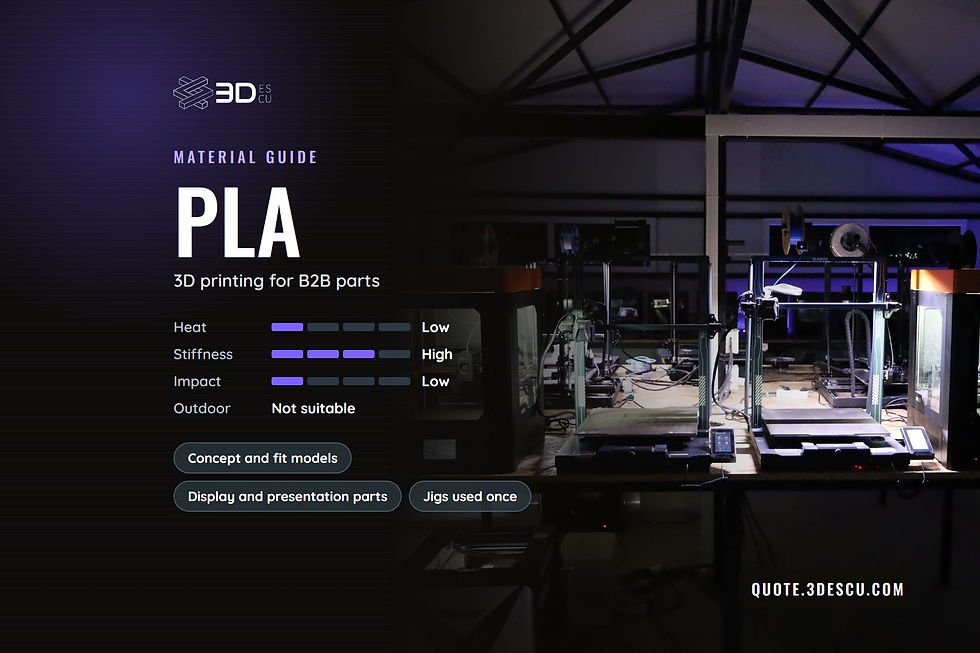
ABS sits in the middle of the engineering range. It is the step up from PETG when heat or knocks enter the picture, and the step below polycarbonate when they are moderate.
Housings near warm electronics. Power supply covers, controller enclosures, fan shrouds. ABS stays rigid where PLA softens and PETG starts to struggle.
Engineering and automotive parts. Brackets, clips, covers and prototype parts that will be knocked about during assembly and use.
Parts that will be drilled or tapped. A mounting plate whose holes are positioned at assembly, or a housing where a hole is added after a fit check. ABS responds well to both.
Assemblies that are glued or solvent bonded. Including parts larger than a single build volume, printed in sections and joined. See large-format 3D printing for how splits are planned.
Parts that need a gloss surface. ABS accepts acetone smoothing, which turns a layered surface into a glossy one.
Shrinkage and warping: the ABS design constraint
With ABS, shrinkage is the constraint, not strength. ABS shrinks as it cools, and a long thin or large flat part pulls inwards as it does, which shows up as a bow along its length or corners lifting off the flat. Designing around it costs far less than reprinting.
Add ribs. A rib along the back of a long flat face resists the bow and adds stiffness at the same time.
Break up large flat faces. A continuous flat panel is on the wrong-for list. Split it at a joint that was going to exist anyway, and bond the pieces.
Recheck fits made in PLA. A fit confirmed on a PLA prototype is not automatically a fit in ABS, because PLA barely shrinks. Check the first ABS part against its mating parts before a batch.
Say which dimensions matter. Where dimensional accuracy matters more than toughness, ABS is the wrong material. Where only a few dimensions matter, name them in the notes and the part is oriented for them.
Beyond shrinkage, the 3Descu design rules apply as for any filament: walls in multiples of the 0.42 mm extrusion width (four or five passes for a load-bearing part, set on the quote form), the load direction stated in the notes because the part is weakest between layers, and chamfers instead of supports on overhangs past about 45 degrees.
If the shrinkage cannot be designed out, the answer is usually ABS CF rather than a different polymer.
ABS CF: when plain ABS bows
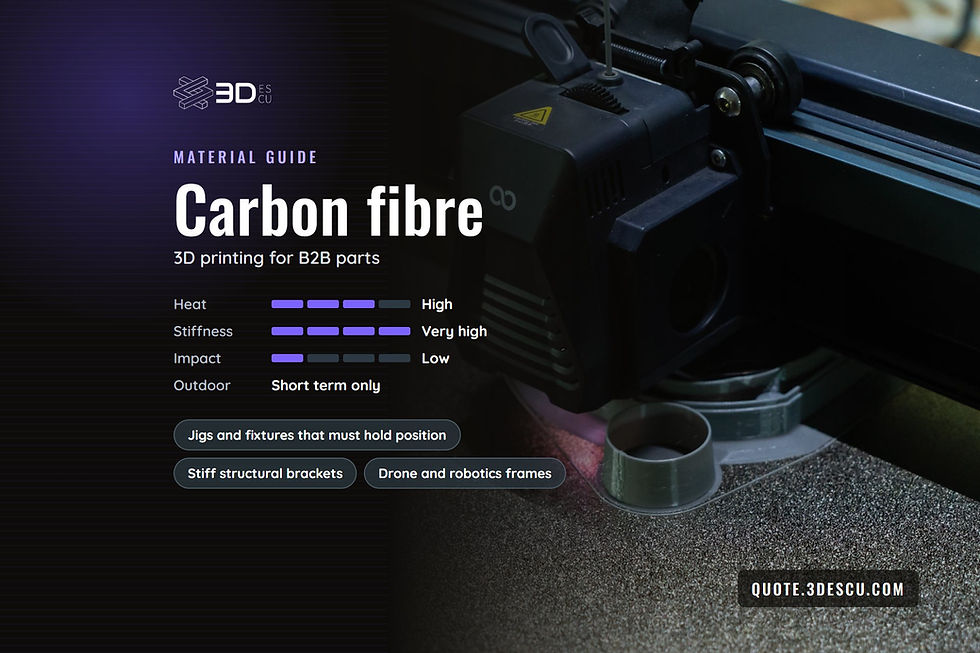
ABS CF is ABS with chopped carbon fibre, and the fibre solves the one thing that makes large ABS parts difficult. A long flat panel that would bow in plain ABS holds its shape in ABS CF, while keeping the heat resistance and machinability that make ABS an engineering material. It is classified Very high on stiffness and Medium on impact: the fibre trades some toughness for stability.
Choose ABS CF over plain ABS when the constraint is holding a dimension rather than surviving an impact: tooling and production jigs, large flat panels, parts that live near heat, housings that will be drilled or tapped. It is the wrong choice for parts that need to flex, for outdoor parts in direct sun over months, and for fine cosmetic detail straight off the machine. It comes out matte and slightly textured, and it does not take acetone smoothing the way plain ABS does; the fibre stays proud of the softened surface.
Working ABS after printing
A tapped thread in ABS suits a fastener that goes in once or twice; anything opened repeatedly gets a brass heat-set insert, with the hole designed for the insert. ABS bonds well, which makes split-and-join assemblies practical. Acetone smoothing and other finishing is hand work: ask for it in the notes and it is priced in the reply.
ABS vs ASA vs PC-ABS vs polycarbonate vs PETG
Material | Heat | Stiffness |
ABS | High | Medium |
ASA | High | Medium |
PC-ABS | High | High |
Polycarbonate | Very high | High |
PETG | Medium | Medium |
ABS CF | High | Very high |
Material | Impact | Outdoors |
ABS | High | Not suitable |
ASA | High | Suitable |
PC-ABS | Very high | Not suitable |
Polycarbonate | Very high | Short term only |
PETG | Medium | Short term only |
ABS CF | Medium | Not suitable |
Material | Pick it when |
ABS | Warm, knocked, or machined after printing |
ASA | The part lives outdoors |
PC-ABS | Interior parts that take hard knocks |
Polycarbonate | A stated service temperature or load |
PETG | Indoors, handled, wetted |
ABS CF | A large ABS part must not bow |
ABS vs ASA. ASA is ABS reformulated to survive sunlight, with the same heat and impact resistance and without the yellowing and chalking. Outdoors, choose ASA; the price difference is small. Indoors, ABS does the same job.
ABS vs PC-ABS. PC-ABS is stiffer and tougher, classified Very high on impact, and is the usual step up for automotive interior parts and housings that take knocks.
ABS vs polycarbonate. Polycarbonate tops the range on heat and impact, but it prints slowly at high temperature and carries more machine time. Specify it when the part has a stated service temperature or load; otherwise ABS does the job for less.
ABS vs PETG. PETG is the easier default indoors and resists water and cleaning agents. ABS wins when the part gets warm or will be drilled, tapped, bonded or smoothed.
How to order ABS at 3Descu
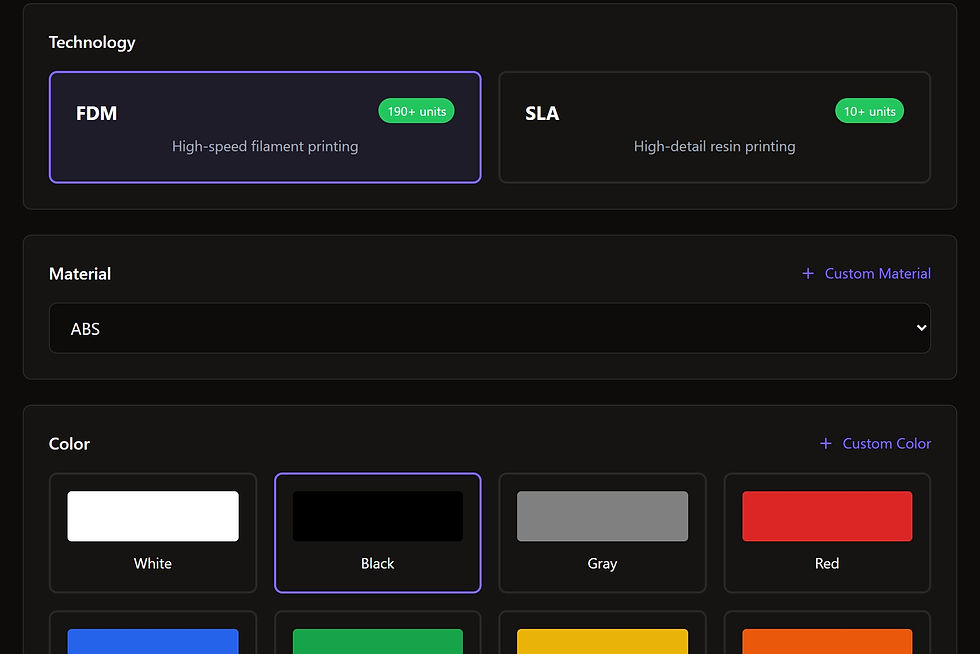
Upload an STL, OBJ, 3MF, STEP or STP file, up to 50 MB per file, to the calculator. A STEP file keeps true curves.
Choose FDM, then ABS or ABS CF, a colour and infill. Set wall thickness under Advanced Settings for load-bearing parts.
In the notes, give the load direction, the dimensions that matter, and any post-processing: drilled holes, inserts, acetone smoothing.
Enter the real quantity; the price per piece and the production estimate update on screen. The minimum is €20 for the whole order.
Submit. A person replies the same business day, and your delivery date is shown with the quote. Production runs 7 days a week, and Express costs 20% more.
If you need a specific ABS grade, such as an ESD-safe one, choose "Custom material" and type its exact name. It is sourced and priced by hand, with the reply the same business day.
ABS 3D printing: key points
ABS is not an outdoor material. Sunlight yellows and chalks its surface; ASA keeps ABS's properties and is made for outdoor use.
ABS warping is shrinkage, solved at the design stage. Ribs, split lines or a move to ABS CF cost far less than a reprint.
Acetone smoothing is available on request. It gives a gloss finish, softens fine detail, is priced with the part when written in the notes, and does not work on ABS CF.
ABS CF is the stable, stiffer ABS. It suits tooling, jigs and large flat panels that bow in plain ABS, and is less tolerant of a hard knock.
Checked by a person before it is printed
An ABS part succeeds or fails on geometry as much as on material, so every quote is read by a person before an invoice is issued, and a long flat face that will bow in ABS gets flagged in the reply with ribs, a split or ABS CF as the alternative. A dimensional QC report is available on request, free on orders over €500, and photos can be sent at any production stage. If a delivered part does not conform to the agreed specification, it is reprinted free of charge or refunded under Article 5.5 of the 3Descu manufacturing contract.
Get a free quote - upload the part and price it in ABS, ABS CF and ASA before you pick one.

Comments