


PC-ABS 3D printing: tough parts between ABS and polycarbonate

Updated: 7 hours ago
PC-ABS 3D printing produces parts in a blend of polycarbonate and ABS that keeps most of polycarbonate's toughness and heat resistance while printing more like ABS. At 3Descu it is the practical middle option for an engineering part that ABS is not quite strong enough for and polycarbonate is more machine time than it justifies, which is why PC-ABS is widely used for automotive interior components and housings that take knocks. If the choice is between ABS and PC and the part is large, PC-ABS is usually the one that ships.
PC-ABS (also written PC/ABS) is printed in filament on the 3Descu fleet of 200+ printers in Targu-Jiu, Romania, and priced instantly from your file.
Get a free quote - no account, and nothing is charged before you accept the offer.
PC-ABS at 3Descu: key facts
PC-ABS | |
Best for | Automotive interior parts; housings that take knocks; engineering parts near warm equipment; larger parts where PC would be too slow |
Wrong for | Outdoor use over months; cost-sensitive work; cosmetic surfaces straight off the machine |
Heat | High |
Stiffness | High |
Impact | Very high |
Outdoors / UV | Not suitable |
Water and chemicals | Not rated; name the fluid in the notes |
Finish | Functional; a cosmetic surface needs finishing |
Colours | 13 standard colours in the calculator; a RAL or Pantone code on request |
Printed on | The FDM fleet: up to 320 x 320 x 320 mm on the standard machines, up to 500 x 500 x 500 mm on the large-format machines |
Layer height | 0.12 mm to 0.28 mm, 0.20 mm by default |
How it is priced | Instantly in the calculator, from your own file |
These classifications are the ones on the PC-ABS material page. They are qualitative on purpose. A printed part does not have the properties of the spool it came from, because orientation, walls and infill all change the result, so write any critical load or temperature in the notes on the quote.
What PC-ABS is and why the blend exists
ABS is easy to print, machine and finish, and it handles heat and knocks well. Polycarbonate goes further on heat and impact but prints slowly and at high temperature. PC-ABS sits between them: it gains stiffness and impact resistance over ABS, keeps a high heat rating, and avoids most of the machine time that makes a large polycarbonate part expensive. The same balance is why it is widely used for automotive interior components, and why, when the production part will be moulded in PC-ABS, a printed prototype in the same blend is a closer stand-in than one in plain ABS.
When to choose PC-ABS
Automotive interior parts: trim brackets, clip mounts, console and dashboard components, fixtures for interior assembly lines.
Housings that take knocks: enclosures for handheld devices, test equipment and control boxes that get dropped or bumped.
Engineering parts near warm equipment: mounts and covers close to motors, drives or power electronics.
Larger engineering parts: where polycarbonate would be too slow and ABS not tough enough. Big parts have their own rules, covered in the large-format 3D printing guide.
Bridge and pre-series parts: small runs before a moulding tool exists, when you want the printed part in a material close to the moulded one. Where printing stops making sense is set out in small batch 3D printing vs injection moulding.
PC-ABS vs ABS vs polycarbonate
Material | Heat | Stiffness |
ABS | High | Medium |
PC-ABS | High | High |
Polycarbonate | Very high | High |
Material | Impact | Outdoors |
ABS | High | Not suitable |
PC-ABS | Very high | Not suitable |
Polycarbonate | Very high | Short term only |
Material | Print behaviour |
ABS | Shrinks, prints readily |
PC-ABS | Shrinks like ABS |
Polycarbonate | Shrinks, prints slowly at high temperature |
Material | Choose it when |
ABS | The part is warm or will be drilled, tapped or smoothed |
PC-ABS | ABS is not quite tough enough and PC would be too slow |
Polycarbonate | The part has a stated service temperature or takes a hard impact |
Choose ABS when heat resistance is the requirement and toughness is not in question; it is easy to drill, tap, glue and smooth after printing. See the ABS guide. Choose polycarbonate when the part carries a stated service temperature or has already failed in something else; the polycarbonate guide covers when that extra machine time is justified. Choose PC-ABS for the wide middle: tough engineering parts, especially large ones, where neither extreme is the right buy.
When PC-ABS is the wrong choice
Outdoor use over months. PC-ABS is not rated for outdoors. For a part that lives in sunlight, choose ASA, which keeps ABS-class heat and impact resistance and survives UV; see the ASA guide.
Cost-sensitive work. If the part only has to survive indoors at room temperature, it probably does not need PC-ABS. Price the same file in PETG and ABS in the calculator and compare.
A cosmetic surface straight off the machine. PC-ABS is an engineering material with visible layer lines. A show surface needs finishing, or a small detailed part belongs in resin.
A part that must flex repeatedly. Snap fits that are opened hundreds of times and living hinges belong in nylon PA12.
Design rules for PC-ABS parts
PC-ABS shares ABS shrinkage behaviour, so the rules for long flat sections apply in full. The general rules are on the 3Descu design rules page.
Break up long flat sections. A long flat panel bows as it cools. Add ribs, or design a split line at a joint that was going to exist anyway. If a large flat part has to hold its shape above all else, ABS CF is the alternative.
Walls, not infill, carry the load. The default shell is two passes of the 0.42 mm nozzle. A housing that takes knocks or carries fasteners wants four or five walls, set under Advanced Settings.
Design bosses for heat-set inserts. Housings are opened for service. A brass insert gives a real machine thread; design the hole for the insert, not the screw.
Orient for the knock. A printed part is weakest between layers. Tell us in the notes where the impact or clip load comes from, so the part is laid out to take it along its layers.
Chamfer overhangs to 45 degrees instead of supporting them where the geometry allows, because supported faces come out rougher.
How to order PC-ABS at 3Descu
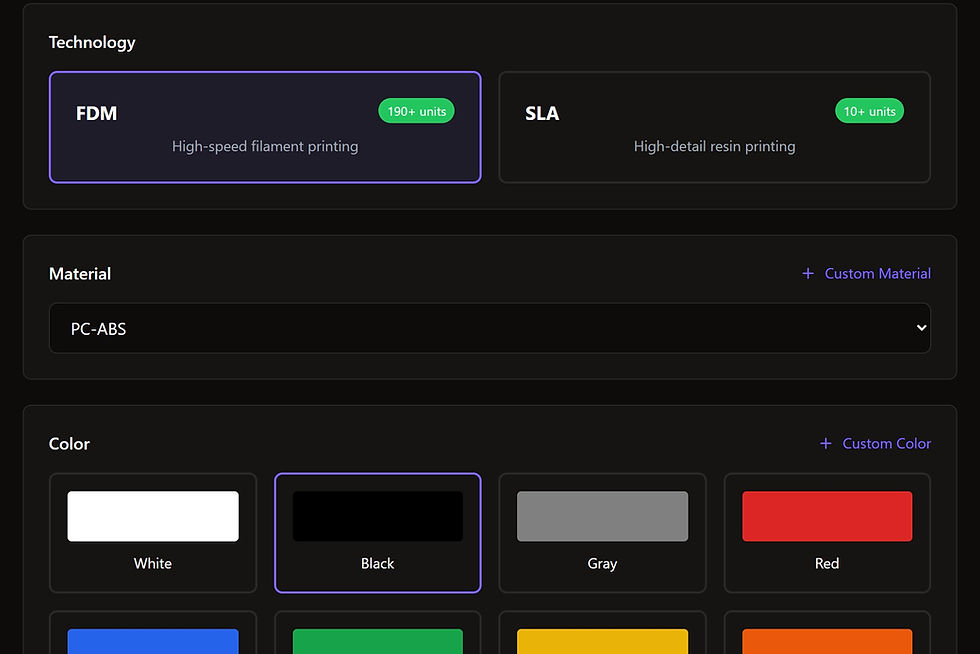
Upload the part to the calculator. A STEP file straight from CAD is preferred.
Choose FDM, then PC-ABS, a colour and an infill. Raise the wall count for housings and brackets.
In the notes, write the environment (temperature, fluids), the load direction and any mating part.
Enter the real quantity. For a pre-series run, price two or three quantities to see how the per-piece price moves.
Submit. A person replies the same business day with the confirmed price.
For a named commercial PC-ABS grade, choose "Custom material" and type it in; an engineer sources it and replies with a price the same business day. The minimum order is €20 per order, not per part.
PC-ABS in short
PC-ABS is a blend of polycarbonate and ABS that keeps most of polycarbonate's toughness and heat resistance while printing more like ABS.
PC-ABS vs ABS: higher on stiffness and impact, equal on heat. ABS is simpler to post-process and takes acetone smoothing.
Heat: rated High, the same as ABS and below polycarbonate. A stated service temperature goes in the notes.
Outdoors: not suitable for months in sunlight. ASA is the outdoor choice.
Car parts: widely used for automotive interior components. For exterior parts in sunlight, ASA.
Quality you can check, and files that stay yours
Automotive and equipment housings are often pre-release designs, so two things matter: the part is right, and the file stays private. Every PC-ABS quote at 3Descu is read by a person who checks the material against the notes before an invoice is issued. On request, photos at any production stage and a dimensional QC report, free on orders over €500, come from an ISO 9001:2015 certified quality system. Files are encrypted in transit and at rest in EU storage and deleted automatically 90 days after upload, and a mutual NDA is signed fast once the text is agreed.
Get a free quote and compare PC-ABS against ABS and polycarbonate on your own housing.

Comments