


PETG 3D printing: the default material for functional parts

Updated: 6 days ago
PETG 3D printing is the default for functional parts that will be handled, fastened or wetted. PETG, a copolyester also written PET-G, is tougher than PLA, easier to print than ABS, bends before it breaks, and resists water and most household chemicals. The 3Descu PETG 3D printing service is where most indoor housings, brackets, mounts and functional prototypes start, and a part moves to ABS, ASA or nylon only when heat, sunlight or repeated flexing demands it.
3Descu prints PETG on a fleet of 200+ printers in Targu-Jiu, Romania, and the calculator prices it instantly from your file. This post goes deeper than the materials overview on one question: when is PETG enough, and when is it not?
PETG key facts
PETG at 3Descu | |
Best for | Functional prototypes, enclosures and housings, brackets and mounts indoors, parts in contact with water or cleaning agents |
Avoid for | Parts needing a crisp cosmetic surface straight off the machine, sustained temperatures above roughly boiling water, long unsupported bridges |
Heat | Medium |
Stiffness | Medium |
Impact | Medium: bends before it breaks |
Outdoor / UV | Short term only |
Water and chemicals | Resists water and most household chemicals |
Layer bonding | Strong: noticeably harder to split along the print direction than PLA |
Finish | Strings more than PLA; light cleanup on request |
Colours | 13 standard colours in the calculator; a RAL or Pantone code on request |
Process and size | FDM, up to 320 x 320 x 320 mm on the standard fleet and up to 500 x 500 x 500 mm on the large-format machines |
Pricing | Instant in the calculator, no account needed |
Stiffer variant | PETG CF, also priced instantly |
These are the working classifications from the PETG material page, not data sheet numbers. A printed part's strength depends on orientation, wall count and infill as much as on the polymer, so a part that carries a critical load should say so in the notes on the quote.
When to choose PETG 3D printing
PETG is the material to pick when the question is "will this snap" rather than "will this look right".
Enclosures and housings. Controller boxes, sensor housings, cable and connector covers for indoor equipment. PETG takes a screw boss and a clip without cracking.
Brackets and mounts indoors. Machine-side holders, rail mounts, cable guides, tool holders on a workbench.
Parts that get wet or wiped down. Holders at a washing station, parts in a lab or workshop that are cleaned with ordinary cleaning agents, drainage and splash components.
Functional prototypes. A PETG prototype behaves closer to a moulded part in use than a PLA one, so it tells you more when it is tested.
Short production runs. For batches of an end-use part, see small batch 3D printing vs injection moulding for where printing stops making sense.
When PETG is not enough, and what to pick instead
The part has to | Why PETG falls short | Pick instead |
Stay rigid near sustained heat | Medium heat; wrong above roughly boiling water | ABS, or polycarbonate for more |
Live outdoors for more than a season | Short term only outdoors | |
Hold its shape under load without bending | Medium stiffness | |
Flex thousands of times, slide or wear | A PETG part that fails at the same point after repeated use has a fatigue problem | |
Look right straight off the machine | Strings more than PLA; the surface is less crisp | PLA for a display part |
Designing parts for PETG
The full rules are on the 3Descu design rules page. For PETG, five points carry most of the weight.
Load goes through the walls. Draw walls in multiples of the 0.42 mm extrusion width. The default shell is 0.8 mm, two passes; a bracket or a mount wants four or five, set in the quote form rather than modelled in.
Avoid long unsupported bridges. PETG is on the wrong-for list for them. Shorten the span, add a chamfer under it, or change the orientation so the span becomes a wall.
Orient for the load. PETG's layer bonding is strong, but a part is still weakest between layers. State the load direction in the notes and the part is oriented for it.
Threads and fasteners. Anything opened more than once gets a heat-set insert. Design the hole for the insert, not for the screw.
Small islands string. A part with many small separate features, such as a grille or a row of pins, may need light cleanup. Ask for it in the notes and it is done before packing.
Snap fits deserve a note of their own. PETG bends before it breaks, so a clip that engages a handful of times works. A clip that cycles all day belongs in nylon.
PETG vs PLA vs ABS vs ASA vs PETG CF
Material | Heat | Stiffness |
PETG | Medium | Medium |
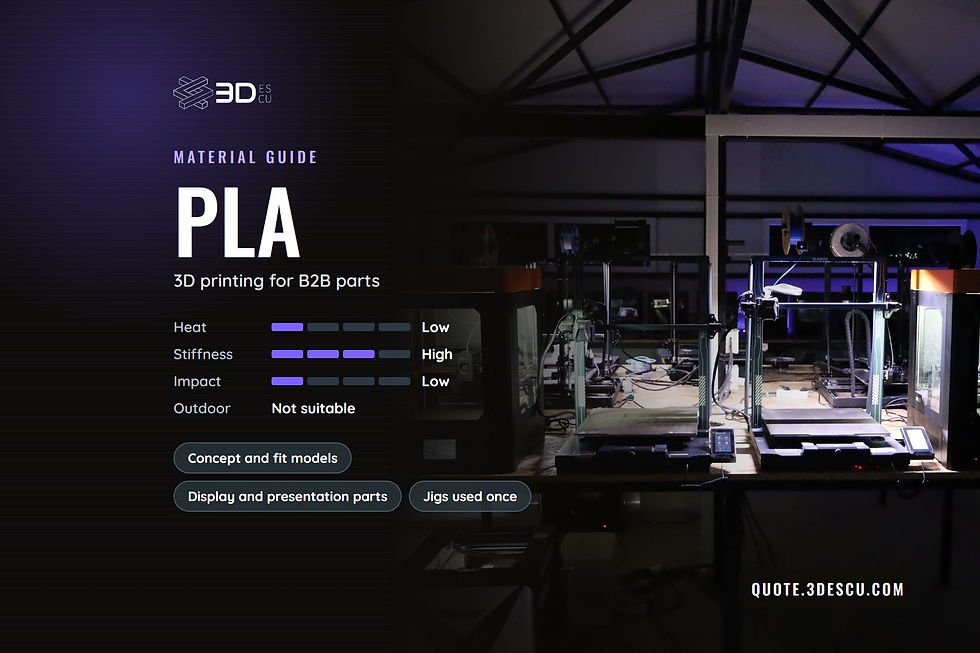
PLA | Low | High |
ABS | High | Medium |
ASA | High | Medium |
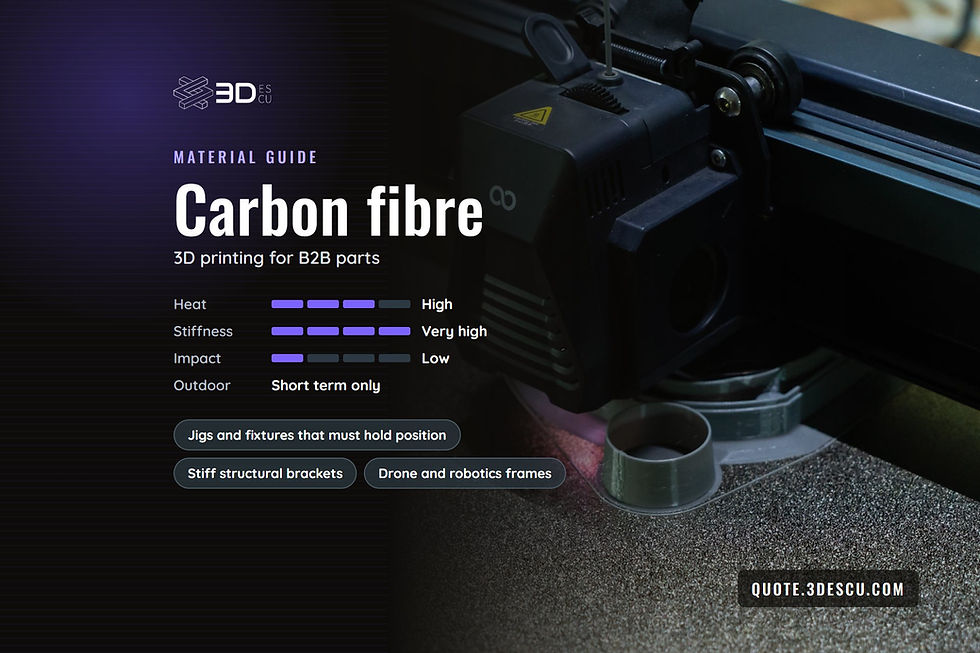
PETG CF | Medium | High |
Material | Impact | Outdoors |
PETG | Medium | Short term only |
PLA | Low | Not suitable |
ABS | High | Not suitable |
ASA | High | Suitable |
PETG CF | Low | Short term only |
Material | Water and chemicals |
PETG | Resists water and most household chemicals |
PLA | Not rated |
ABS | Softened by acetone |
ASA | Not rated |
PETG CF | Same resistance as PETG |
Material | Pick it when |
PETG | The part is handled, fastened or wetted indoors |
PLA | It only has to look right or prove a fit |
ABS | It gets warm or will be drilled and tapped |
ASA | It lives outdoors |
PETG CF | A PETG bracket bends under load |
PETG vs PLA: PLA is stiffer and more accurate, PETG is tougher and survives handling. PETG vs ABS: ABS handles heat and post-machining better, PETG handles water and is the easier default. PETG vs ASA outdoors: PETG copes for a short time; ASA is made for sunlight.
How to order PETG at 3Descu

Upload an STL, OBJ, 3MF, STEP or STP file (up to 50 MB per file) to the calculator, choose FDM, PETG, a colour and infill, then set wall thickness under Advanced Settings if the part carries load. The notes box takes the load direction, the dimensions that matter and any cleanup. Enter the real quantity: the price per piece falls as setup is shared across a batch, and the minimum is €20 for the whole order.
A person reads the quote and replies the same business day. Production runs 7 days a week, and small orders can be printed in as little as one day. If you need a specific brand or grade of PETG, choose "Custom material" and type its exact name; it is sourced and priced by hand, with the reply the same business day.
PETG 3D printing: key points
PETG is tougher than PLA, not stiffer. PLA is classified High on stiffness and PETG Medium, but PETG bends before it breaks and its layers are noticeably harder to split, so it survives handling, drops and fastening where PLA snaps.
PETG heat resistance is classified Medium. It is the wrong choice for sustained temperatures above roughly boiling water; housings around warm electronics or parts near a motor move to ABS or polycarbonate.
PETG outdoor use is short term only. A part that stays outside for more than a season belongs in ASA.
Food contact is answered per part, not per material. None of the 3Descu material pages rate a filament for food contact, and a printed part differs from the raw polymer because layer lines hold residue. A part that must touch food or drinking water is named in the notes, and material data sheets can be supplied on request.
PETG CF is PETG with chopped carbon fibre. It is stiffer, less tolerant of a hard knock, keeps PETG's resistance to water and cleaning agents, and warps far less on long flat geometry: the fix for a PETG bracket that holds its shape at rest but bends under load.
A second pair of eyes on every PETG quote
PETG is the default, and defaults are where a wrong choice slips through. That is why a person checks the material against what the part has to survive before any invoice is issued, and the reply says so if PETG is the wrong call. On request you get a dimensional QC report, free on orders over €500, and photos at any production stage, from an ISO 9001:2015 certified shop. If a delivered part does not conform to the agreed specification, it is reprinted free of charge or refunded under Article 5.5 of the manufacturing contract.
Get a free quote - upload your part and price it in PETG and ASA side by side.

Comments